Promote a new website by starting with people who already understand the problem, giving each channel a useful reason to care, and measuring qualified actions instead of raw reach. Combine owned communication, relevant communities, selective directories, useful follow-up content, and honest partnerships rather than posting the same announcement everywhere.
The short answer
What is the best way to promote a new website?
Start with an instrumented, working destination and one clearly defined audience. Use the launch burst to reach people who already know the problem, convert attention into email permission and feedback, then spend 90 days publishing useful content, participating in relevant communities, earning independent references, and improving the conversion path. Scale channels by qualified outcomes, not reach.
The plan should leave durable assets behind: indexed pages, an owned audience, stronger product evidence, trusted profiles, genuine reviews, editorial mentions, repeatable partnerships, and a record of which channels create customers.
1. Organize promotion around four outcomes
Relevant visits
Reach people with the problem and enough context to evaluate the website. Qualified visits matter more than a traffic spike.
Useful feedback
Observe what visitors misunderstand, cannot complete, or expected to find. Turn qualitative and behavioral evidence into fixes.
Durable references
Earn accurate links, mentions, listings, reviews, examples, and citations that continue to support discovery after the launch.
Measurable next steps
Know which message, audience, page, and channel deserves another month of work—and which one should stop.
Choose one primary conversion for the quarter: an activated account, qualified enquiry, completed purchase, booking, subscriber who confirms, site submission, or another action tied to the business. Supporting events explain the path; they do not replace the outcome.
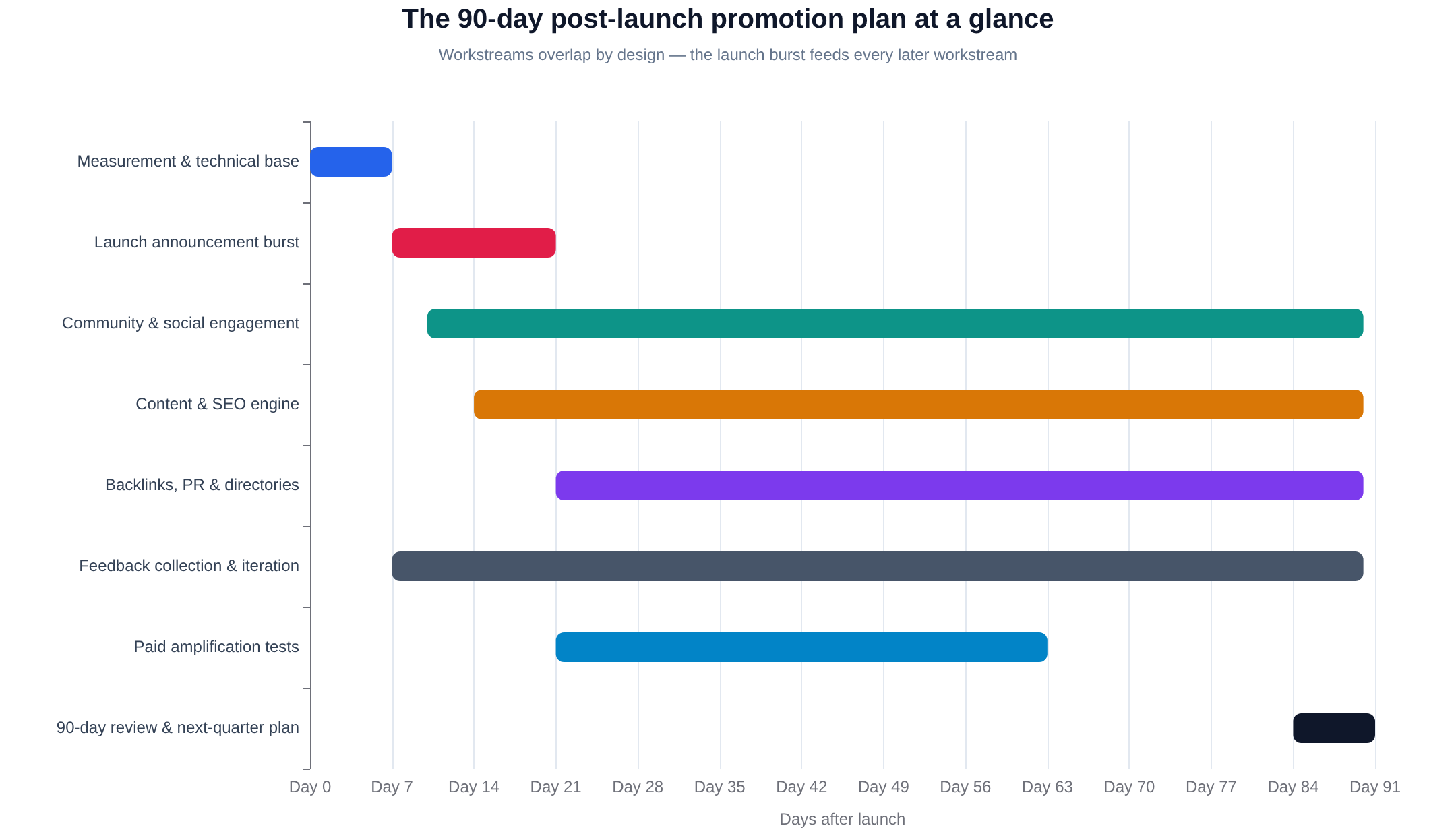
2. Days 1–7: instrument and observe before adding reach
Promotion magnifies both value and friction. Complete the live website launch checklist, verify search ownership and indexing controls, and trace the primary journey from landing page to the business system that receives the result.
| Setup | Minimum implementation | Proof it works |
|---|---|---|
| Search | Google Search Console, Bing Webmaster Tools, canonical sitemap, representative URL inspection | Ownership verified; sitemap read; priority URLs accessible without unintended blocks |
| Analytics | Traffic sources plus events for the primary outcome and critical funnel steps | A controlled live journey appears with correct source, event, and properties |
| Reliability | Uptime, exceptions, queue or webhook health, payment/email/provider monitoring | Controlled test signal reaches the assigned owner |
| Feedback | Reply route, short survey, support log, optional privacy-reviewed behavior analytics | A visitor can report a problem and the team can connect it to a page or journey |
| Attribution | Documented campaign naming and tagged links without personal data | Test links appear in the intended source/medium/campaign grouping |
| Baseline | Pre-promotion traffic, conversion, search, email, and product state recorded | Later change can be compared with a dated starting point |
Use behavior tools carefully
Session replay, heatmaps, and on-page surveys can reveal missed calls to action, repeated clicks, form abandonment, and unexpected mobile behavior. They can also collect sensitive information if configured badly. Mask inputs, exclude private and account areas, honor consent and privacy choices, restrict access and retention, and review the vendor’s current controls before installation.
3. Days 7–14: run a focused launch burst
Use the website launch announcement guide to prepare the core message. Start with channels where the relationship already exists: customers affected by the change, opted-in subscribers, collaborators, professional contacts with a legitimate interest, and maintained owned profiles.
- 01
Send the owned announcement
State what launched, who it helps, the primary benefit, and one next action. Segment customers, prospects, partners, and general subscribers when their context differs.
- 02
Publish the durable story
Create a canonical article or update page with the reasoning, demonstration, limitations, screenshots, support route, and links that social posts cannot hold.
- 03
Adapt social content
Use the formats and language that fit each maintained channel. A short demonstration or specific lesson usually travels better than a logo and “we’re live.”
- 04
Activate one launch venue
Choose a launch platform, community, directory, marketplace, or niche newsletter by audience fit. The launch directory guide provides the scorecard.
- 05
Staff the response
Reply to questions, acknowledge defects, invite the requested feedback, and record recurring language. The conversation is part of the launch, not an interruption.
Use incentives only when they improve product fit rather than inflate an empty number. A trial extension, relevant resource, launch bundle, or founding-customer arrangement may make sense. False scarcity, hidden renewal terms, review incentives tied to sentiment, or contests built around spam sharing do not.
4. Days 10–90: build a community and content engine
Choose communities by questions, not member count
Find two to four places where the intended audience asks the exact questions the product solves. Read the rules, identify recurring threads, and contribute without links when the answer does not need one. A useful operating ratio is qualitative rather than numeric: most activity should help other people; self-reference should be occasional, relevant, disclosed, and supported by substance.
Keep a listening log with the question, audience wording, current workaround, objection, linked resources, and follow-up. This becomes product research and the content backlog. Never coordinate votes, evade moderation, impersonate customers, or outsource fake participation.
Build content from verified demand
Prioritize topics at the intersection of audience need, product credibility, and a realistic way to add original value. Search Console queries, sales calls, community threads, support questions, customer interviews, internal search, and competitor gaps are stronger inputs than raw keyword volume.
| Content asset | Promotion role | What makes it durable |
|---|---|---|
| Definitive guide | Answers a high-value recurring question | Direct answers, first-hand detail, examples, primary sources, maintained updates |
| Template or tool | Creates immediate utility and an email or product entry point | Useful without a sales call, clear license, version history, documentation |
| Comparison | Helps evaluation and intercepts existing demand | Fair criteria, dated facts, stated limitations, update process |
| Original research | Creates a citation and PR reason | Transparent methodology, stable snapshot, definitions, reusable aggregates |
| Customer case | Shows the product in a real context | Permission, baseline, method, result, limits, representative language |
| Changelog or build note | Turns product improvement into follow-up | Specific change, reason, affected users, migration/support information |
Distribute every important asset deliberately: email the relevant segment, answer the community thread that inspired it, brief partners who serve the same audience, add contextual internal links, and pitch publications only when the asset contributes to their work. Republishing the headline everywhere is not a distribution plan.
5. Days 21–90: earn durable references
A durable reference exists because another source found something worth naming, not because a marketplace sold a link. The most repeatable sources are original data, useful free tools, expert explanations, resource-page inclusion, partner integrations, customer evidence, unlinked-mention reclamation, and timely contributions to reporting.
Original evidence
Publish a method, dataset, benchmark, or observed pattern with a clear methodology and assets another writer can cite.
Useful product asset
A calculator, template, public dataset, glossary, or technical reference can earn repeat use and links when it solves a real task.
Resource-page outreach
Find a maintained page where the asset genuinely fills a gap. Explain the fit in one short, personalized note.
Expert contribution
Offer a specific observation, data point, example, or source to a relevant journalist, newsletter, podcast, or association.
Unlinked mention
When a source already names the brand, politely suggest the canonical page that helps its readers verify the reference.
Purchased authority
Link marketplaces, private networks, fake reviews, bulk guest posts, and automated directory campaigns create risk without audience trust.
Pitch the evidence, not the company biography. A useful note answers: why this matters to the recipient’s audience, what is new, how it was established, where the data or demonstration lives, and who can answer questions. Follow up once when you have something useful to add; respect a no or silence.
6. Run a weekly feedback-to-proof loop
- Collect
Bring signals together
Review conversion paths, errors, search queries, session observations, surveys, support messages, launch comments, sales notes, and churn reasons.
- Classify
Separate friction, confusion, and missing value
Friction prevents a known action; confusion makes the promise unclear; missing value is something the audience reasonably expected but cannot find.
- Prioritize
Fix by harm and frequency
Start with safety, payment, access, data loss, accessibility, and high-frequency conversion blockers. Do not let a loud edge case displace a common failure.
- Ship
Change one interpretable thing
Record the hypothesis, release time, affected pages, and expected signal. Avoid bundling unrelated changes that make the result unreadable.
- Verify
Compare behavior and ask again
Confirm the technical result, then review the same quantitative and qualitative signal over an appropriate period.
- Publish
Turn improvements into evidence
Update help content, changelog, FAQ, and follow-up communication. Credit the feedback source when permission allows.
Ask for evidence ethically
Ask a customer for an honest review, testimonial, case discussion, or referral only after they have enough experience to form an opinion. Invite all appropriate customers rather than only expected promoters. Do not condition an incentive on positive sentiment, and disclose material relationships. Follow the platform rules and applicable law; the FTC review guidance provides a useful US reference.
7. Days 21–70: test paid amplification selectively
Paid promotion has three legitimate early roles: testing positioning against a defined audience, bridging the wait for slower organic channels, and returning known visitors to a relevant next step. It should not compensate for an unreliable page or unclear offer.
- Start after the primary conversion path and analytics have passed live tests.
- Write the hypothesis: audience, message, destination, conversion, maximum cost, test period, and stop condition.
- Use narrow high-intent search terms, a relevant newsletter, a credible creator partnership, or privacy-compliant retargeting—not broad reach by default.
- Send each ad or sponsorship to the page that fulfills its promise rather than the generic homepage.
- Disclose sponsored or creator relationships clearly and provide accurate claims and assets.
- Judge cost per activated user, qualified lead, purchase, or retained customer; clicks and impressions are diagnostic.
- Scale only after conversion quality and operational capacity remain healthy.
Do not copy generic CPC, CPM, or “return per dollar” benchmarks into the budget. Obtain current estimates for the exact market and compare them with real unit economics: gross margin, sales completion, retention, refunds, support load, and payback period.
8. Review the system at 30, 60, and 90 days
| Review | Evidence to bring | Decision to make |
|---|---|---|
| Day 30 | Index status, channel baseline, primary conversion, launch questions, shipped fixes, owned-audience growth | Which audience and message deserve the next month? What must be fixed before adding reach? |
| Day 60 | Search impressions and queries, content entry points, community learning, referral quality, early references, retention | Which content and relationship work is beginning to compound? Which activity is merely busy? |
| Day 90 | Value per channel and hour, durable vs rented acquisition, customer evidence, paid-test verdicts, assistant citations, operational load | Scale two channels, repair one constraint, stop one weak activity, and define the next quarter’s evidence assets. |
Keep one-page promotion metrics
- Leading work: useful assets published, community contributions, customer conversations, pitches, profiles maintained, experiments completed.
- Discovery: indexed priority pages, impressions, ranking queries, referring domains, brand mentions, directory referrals, assistant citations.
- Audience: qualified sessions, email permission, returning visitors, direct demand, relevant geography and company fit.
- Product: activation, primary conversion, retention, support load, failed journeys, feedback themes, fixes validated.
- Economics: labour and spend per channel, cost per qualified outcome, revenue quality, payback, operational capacity.
9. Adapt the plan by website type
| Website type | Emphasize | Signature assets | Primary outcome |
|---|---|---|---|
| SaaS or product | Activation, comparison demand, documentation, integration ecosystems, review evidence | Free tool/template, alternatives page, technical guide, customer workflow | Activated and retained account or qualified demo |
| E-commerce | Merchandising, email permission, lifecycle flows, reviews, creator fit, shopping surfaces | Buying guide, product comparison, use demonstration, customer photos with permission | Contribution margin, repeat purchase, qualified subscriber |
| Content or research | Distinctive reporting, newsletter, source relationships, original datasets, topic authority | Investigation, benchmark, methodology, visualization, reusable dataset | Returning reader, subscriber, citation, membership |
| Local service | Eligible business profiles, trusted local sources, service clarity, reviews, fast contact | Service-area guide, transparent process, local case, booking or quote path | Qualified call, booking, visit, or enquiry |
| Marketplace or directory | Supply quality, taxonomy, programmatic discovery, research, contributor trust | Category pages, market report, methodology, curated collection | Useful search, submission, claim, repeat discovery |
Post-launch promotion mistakes to avoid
- Announcing before conversion tracking, error monitoring, and support are working.
- Repeating one message in every channel instead of adapting to the audience.
- Entering communities only to drop a link or coordinate votes.
- Publishing generic content on a rigid cadence without original value or distribution.
- Buying bulk links, directory volume, fake reviews, or undisclosed creator endorsements.
- Sending paid traffic to a generic or unproven destination.
- Optimizing traffic, followers, and impressions while activation and retention stay weak.
- Abandoning compounding work because it did not behave like launch-day traffic.
- Running many channels without a stop condition or the capacity to follow up.
Marketing, privacy, review, advertising, and outreach rules vary by jurisdiction and platform. Verify current requirements and provider terms. Channel examples and time windows are planning frameworks, not performance guarantees.
Frequently asked questions
What is the best way to promote a newly launched website?
- Start with a clearly defined audience and a useful message, then use channels where that audience already pays attention. Combine existing relationships, relevant communities, selective directories, and useful follow-up content while measuring qualified actions.
Where should I share a new website?
- Share it through relevant customer or subscriber communication, founder and industry communities, suitable launch directories, professional networks, and publications that cover the problem or market. Audience fit matters more than the number of channels.
How long should website launch promotion continue?
- Treat launch day as the start of a campaign. Review early results after about a week, follow up when you have useful feedback or evidence, and continue only in channels that create relevant visits, conversations, references, or conversions.
Sources and methodology
LaunchIndex Research reviews this guide against primary documentation and the public LaunchIndex methodology. Platform behavior can change, so the updated date is part of the record.
- Google guidance on helpful, people-first content
- Google guide to getting a website discovered
- Bing Webmaster Tools help
- Google Analytics campaign URL guidance
- FTC guidance on endorsements and advertising disclosures
- ICO direct marketing and electronic communications guidance
Explore LaunchIndex data
Browse the new website directory or review published aggregate research. Launch profiles record when LaunchIndex first observed a public website live; they are not claims about an official launch date.