To get a new website discovered, make it crawlable, describe it clearly, publish a few genuinely useful pages, submit it to relevant discovery channels, and earn real references from places your audience already trusts.
The short answer
How do you get a new website discovered?
Make every important page crawlable and internally linked, verify the site with Google and Bing, submit a clean sitemap, and publish pages that answer real audience questions. Then place the website in a few relevant directories and communities, recruit early users directly, and earn accurate third-party references. Measure indexing, referrals, conversations, citations, and conversions separately.
Discovery is not the same as ranking. A crawler can know a URL exists without indexing it, an index can contain a page without ranking it, and a directory visit can produce a customer before search traffic appears. Work on all five systems in parallel instead of waiting for a single channel.
1. Use the five-system discovery model
A new domain starts without crawl history, branded demand, references, reviews, or an established audience. The job is to create accurate evidence that the website exists, solves a specific problem, stays maintained, and is worth returning to.
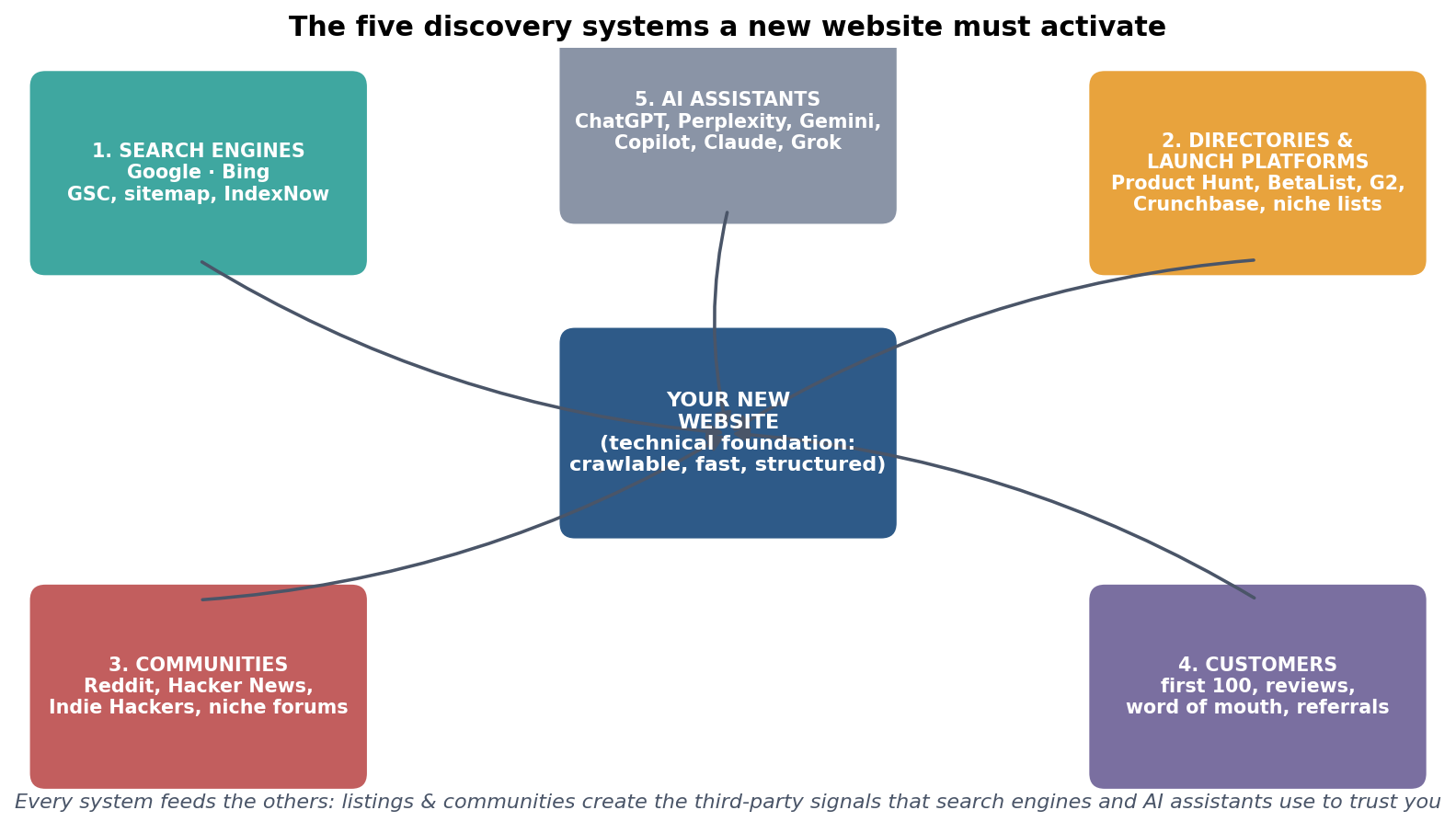
| System | How discovery happens | What you control | Early evidence |
|---|---|---|---|
| Search engines | Crawlers follow links, sitemaps, and update signals, then decide whether to index and rank pages | Access, HTML, internal links, sitemaps, page quality, canonicals | Crawl activity, indexed pages, impressions |
| Directories | People browse or search a curated catalogue, launch board, marketplace, or review platform | Audience fit, accurate profile, assets, participation, tracking | Approved listing, qualified referral visits, conversations |
| Communities | Members recommend useful resources or respond to a substantive contribution | Relevance, generosity, disclosure, follow-up | Replies, saved posts, direct questions, repeat mentions |
| Customers | Early users share the product, leave evidence, or introduce another buyer | Who you recruit, activation, support, review and referral prompts | Activation, retention, referrals, honest reviews |
| AI assistants | Search and retrieval systems select accessible sources that support an answer | Crawler access, clear facts, source quality, entity consistency, corroboration | Bot requests, brand mentions, cited URLs, referral conversions |
2. Build the technical foundation before promotion
Discovery work compounds only when the destination is stable. Run the website launch checklist first, then verify these discovery-specific conditions on the live production origin.
- Every important public page returns a useful response and meaningful server-rendered HTML without requiring sign-in or a client-side action.
- Ordinary HTML navigation links the homepage to the main product, category, guide, pricing, about, and contact pages.
- One canonical HTTPS URL represents each page; redirects, internal links, sitemap entries, sharing metadata, and structured data agree.
- Production robots.txt permits intended search and retrieval crawlers while private, administrative, and faceted areas remain protected appropriately.
- Public templates do not inherit a staging
noindexdirective; private and deliberately thin pages still use the intended controls. - The XML sitemap contains only canonical, useful, indexable URLs and reports accurate modification times where the implementation can support them.
- Page titles, opening paragraphs, headings, image alternatives, and structured data explain visible content consistently.
- Analytics, server logs, and search-console access are ready before the first distribution push.
Make the brand unambiguous
Create an entity home—usually the About page—that states the organization’s name, canonical website, product or service, audience, operating status, contact route, and maintained official profiles. Use Organization structured data to clarify those visible facts, not to manufacture authority. Add sameAs only for profiles the organization actually controls and keeps accurate.
For local discovery, create a Google Business Profile only if the business meets Google’s eligibility rules. Google says online-only businesses without face-to-face customer contact are not eligible. A directory listing or Organization schema is not a workaround for that policy.
3. Help Google and Bing discover the site
Google’s getting-on-Google guide says its systems automatically look for sites and often discover new pages through links from known pages. A new site may be missed because it is not linked elsewhere, is too new, blocks access, returns errors, or makes content hard to crawl. The practical workflow is straightforward:
- 01
Verify ownership
Add the production property to Google Search Console and Bing Webmaster Tools. Prefer a domain-level verification method when it fits the organization’s access model.
- 02
Submit the sitemap
Submit the canonical sitemap in both tools and reference it in robots.txt. Treat submission as a discovery signal, not an indexing guarantee.
- 03
Inspect representative URLs
Check the homepage, core conversion page, key guide, and a deeper page. Confirm the fetched URL, response, rendered content, canonical, and index controls.
- 04
Request priority recrawls sparingly
Use the official inspection tools for a small number of important new or corrected URLs. Do not automate Google’s restricted Indexing API for ordinary web pages.
- 05
Create real crawl paths
Link new pages from relevant hubs and earn a small number of legitimate external references. Do not buy links or mass-create profiles merely to trigger crawling.
- 06
Diagnose exclusions
Separate “not discovered,” “crawled but not indexed,” duplicate/canonicalized, blocked, redirected, and error states. Each requires a different response.
Use IndexNow for participating search engines
IndexNow lets a site notify participating search engines when URLs are added, updated, or deleted. Bing recommends it for automated submission and exposes activity in Webmaster Tools. Use a supported CMS/CDN integration or implement the documented key and endpoint flow. Submit only changed canonical URLs and monitor responses; notification still does not guarantee indexing or ranking.
4. Publish useful entry points, not a pile of launch posts
A homepage explains the product, but it rarely answers every discovery query. Build a small library around the problems a prospective user has before, during, and after choosing the product. Each page should have a distinct purpose and enough first-hand value to deserve its own URL.
| Page | Question it answers | Evidence to include |
|---|---|---|
| Use-case page | Can this solve my situation? | Workflow, constraints, example inputs and outputs, who it is not for |
| How-to guide | How do I solve the underlying problem? | Steps, screenshots, decisions, edge cases, primary sources |
| Comparison | How do the credible options differ? | Named criteria, current facts, review date, fair limitations |
| Original research | What is happening in this market? | Methodology, sample, period, definitions, downloadable aggregate data |
| Documentation | Can I implement or evaluate this? | Prerequisites, exact steps, examples, expected result, failure modes |
| Customer evidence | Has this worked in a real context? | Named or properly anonymized situation, method, result, limitations, permission |
Lead each section with the answer, then add the explanation. Use descriptive headings, dated facts, visible authorship, and links to original sources. Update a page when the answer changes; do not change the date merely to simulate freshness. Google’s people-first content guidance is a better long-term standard than producing keyword variations for crawlers.
5. Borrow relevant audiences through directories and launch platforms
Choose a channel because the intended audience uses it and the submission format matches the product’s stage. A launch board can create a concentrated conversation, a curated directory can create a durable discovery page, a marketplace can reach ready buyers, and a review platform becomes useful when real customers can contribute evidence.
Prepare one accurate submission kit
- Canonical product name, homepage URL, and concise explanation of what it does and for whom.
- Short and long descriptions written as facts rather than superlatives.
- Current screenshots, square logo, social preview, pricing model, supported platforms, and contact route.
- Founder or publisher identity, relevant category choices, official launch status, and disclosure of paid placement.
- Campaign-tagged destination URL that contains no personal information.
- A review date and owner for keeping approved profiles accurate.
Submit first to three to five strong-fit channels and evaluate the outcome. Adapt the explanation to the audience; do not publish identical promotional copy across dozens of low-quality catalogues. The dedicated website launch directories guide compares channel types and provides a selection framework.
6. Earn discovery through communities and early customers
Participate before you promote
Choose a few communities where buyers, practitioners, or peers already discuss the problem. Read the rules and recent high-quality threads. Answer questions with enough detail that the contribution remains useful if the product link is removed. Disclose your relationship when you mention your own site, accept criticism, and return with an update when the discussion changes the product.
A useful community post usually contains a real artifact: a technical breakdown, dataset, teardown, open-source component, launch lesson, or clear demonstration. “We launched—thoughts?” asks the audience to manufacture the value.
Recruit the first customers directly
Early discovery is often manual. Make a small list of people or organizations with the exact problem, explain why the product may fit, and offer a low-friction way to evaluate it. Use only contact methods you are entitled to use and respect platform, privacy, and marketing rules.
Turn successful use into evidence with permission: a quote with context, a case study, an introduction, a public example, or an honest review on a relevant platform. Ask after a meaningful outcome, make the request optional, and never script the sentiment. Useful criticism is a discovery asset too because it improves the message and the product before more people arrive.
7. Make the website retrievable by AI assistants
Assistants with web search need accessible sources that can support an answer. There is no universal “submit to every LLM” button and no schema that guarantees a citation. Treat assistant discovery as the intersection of search access, clear public facts, citable evidence, and independent corroboration.
- 01
Choose crawler policy by role
Review each provider’s current documentation for search, user-requested retrieval, and model-training agents. Allow or block them deliberately instead of copying an obsolete user-agent list.
- 02
Verify the delivery layer
Confirm the CDN and firewall do not challenge verified crawlers you intend to serve. Inspect status codes and logs; a permissive robots.txt cannot override an upstream block.
- 03
Publish extractable facts
State what the product does, audience, geography, pricing model, dates, limitations, and evidence in visible HTML. Keep each important answer understandable outside its surrounding page.
- 04
Use structured data for clarity
Describe visible organizations, articles, products, authors, dates, and breadcrumbs accurately. Do not mark up hidden FAQs or unverified relationships.
- 05
Earn corroboration
Seek accurate mentions, reviews, discussions, and editorial references from sources that already serve the audience. Repetition of a marketing claim is not independent evidence.
- 06
Measure a fixed prompt set
Repeat the same unbranded and branded questions across selected assistants; record mentions, citations, accuracy, competing sources, and downstream actions.
See the full AI discovery guide for current crawler roles, answer structure, entity clarity, earned evidence, and measurement.
8. Measure whether the site is becoming discoverable
Track leading indicators and business outcomes together. An indexed page is progress, not success; a referral visit is interesting, not necessarily qualified; an assistant mention without a citation may be accurate or invented.
| System | Weekly or monthly measures | Decision question |
|---|---|---|
| Search | Valid indexed pages, exclusions by reason, impressions, clicks, branded queries, landing pages | Are useful pages being discovered and matched to relevant searches? |
| Directories | Approval status, durable profile, referral sessions, engaged visits, conversions, replies | Which listings reach the intended audience? |
| Communities | Substantive replies, questions, saves, referrals, later mentions | Where does participation create trust or product learning? |
| Customers | Activation, retention, referrals, reviews, cases, recurring objections | Which early users become credible evidence and advocates? |
| AI assistants | Official crawler responses, prompt mentions, citations, cited URL, factual accuracy, referrals and conversions | Can assistants find and accurately describe the website? |
Annotate launch events, directory approvals, coverage, and major content changes in the measurement record. Review referral quality by channel using consistent campaign parameters. Some assistants suppress referrer information, so combine analytics with server logs, branded search trends, prompt testing, and a “how did you hear about us?” field when appropriate.
9. A practical 90-day founder discovery plan
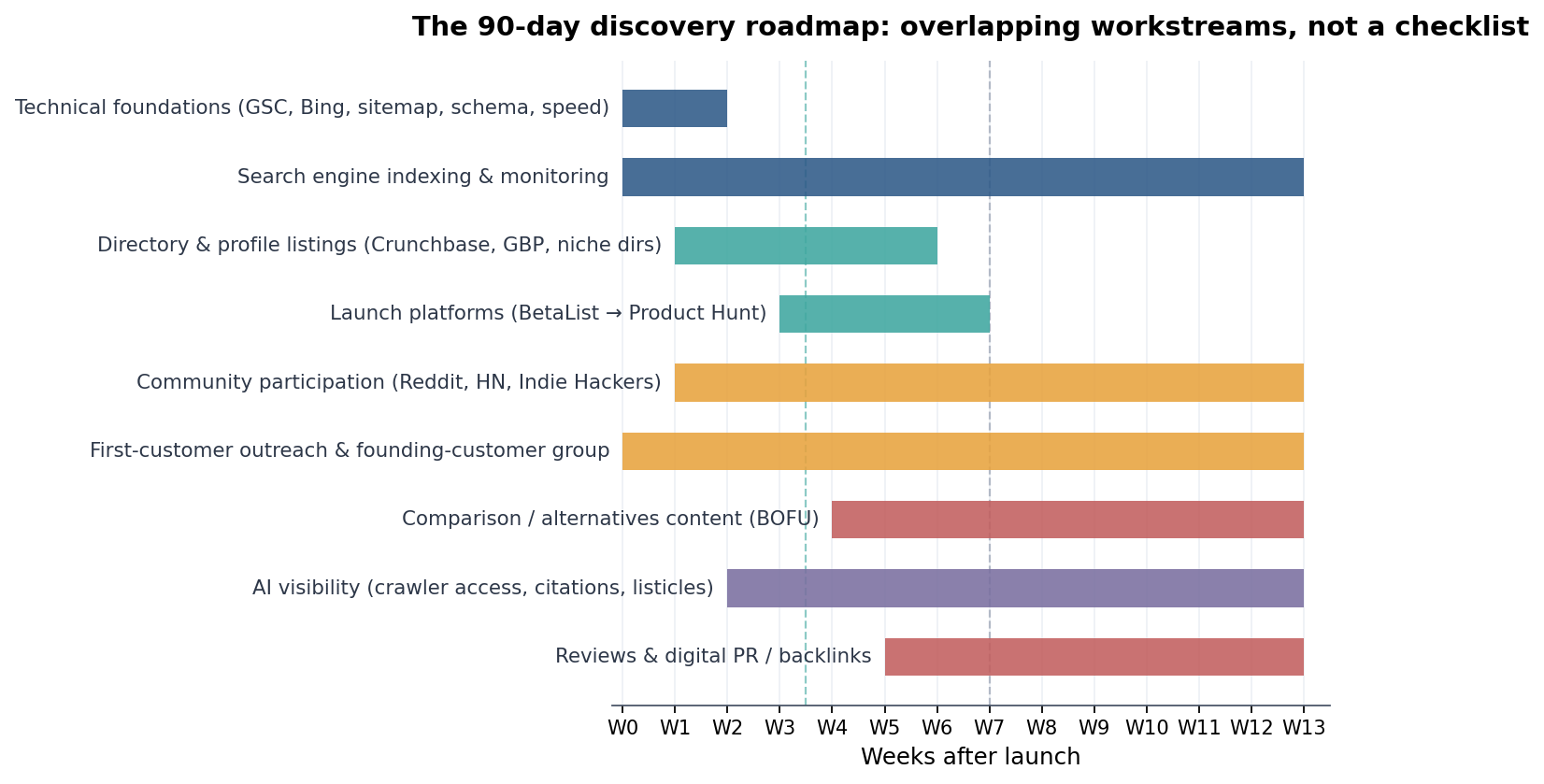
Days 1–14
Make the site legible
- Pass the launch checklist.
- Verify Google and Bing.
- Submit the sitemap and configure IndexNow where appropriate.
- Publish the entity home and two useful answer pages.
- Start the discovery baseline.
Days 15–30
Create the first signals
- Prepare the submission kit.
- Claim maintained official profiles.
- Submit to three to five relevant directories.
- Recruit a small early-user group.
- Contribute to chosen communities without a launch drop.
Days 31–60
Run focused distribution
- Schedule the best-fit launch event.
- Publish a comparison, template, or original finding.
- Ask successful users for permission-based evidence.
- Pitch niche publications or resource pages with a useful angle.
- Audit crawler and index coverage.
Days 61–90
Double down on evidence
- Compare channels by qualified outcomes.
- Fix recurring message and product gaps.
- Refresh the strongest page with new evidence.
- Repeat the assistant prompt benchmark.
- Choose the next-quarter content and authority bets.
Common discovery mistakes
- Waiting for Google while the site has no crawlable internal or external links.
- Confusing sitemap submission, crawling, indexing, ranking, traffic, and conversion.
- Publishing many thin pages before one page answers the audience’s question well.
- Mass-submitting identical copy to irrelevant directories or buying links.
- Entering communities only to promote and abandoning replies after posting.
- Creating empty review profiles before genuine users can contribute.
- Inventing a local presence or structured-data relationship the business cannot verify.
- Allowing search crawlers in robots.txt while the firewall still returns challenges or errors.
- Judging a three-month compounding program by launch-day reach alone.
Search engines, assistants, directories, and communities change their policies and interfaces. Verify current provider documentation before implementing platform-specific steps. This guide does not guarantee crawling, indexing, ranking, recommendation, or commercial results.
Frequently asked questions
How long does a new website take to appear in search?
- There is no guaranteed timetable. Crawlability, internal and external links, sitemap submission, content quality, and the search engine's own scheduling all affect discovery and indexing.
Do launch directories help a new website get discovered?
- Relevant directories can create referral visits and independent references. Their value depends on audience fit, editorial quality, and whether people actually use the directory.
Can AI assistants discover a brand-new website?
- Assistants with web search can retrieve newly indexed pages when their search crawlers are permitted. Clear public content and credible references improve the chance that the site can support an answer.
Sources and methodology
LaunchIndex Research reviews this guide against primary documentation and the public LaunchIndex methodology. Platform behavior can change, so the updated date is part of the record.
- Google guide to getting a website discovered
- Google guide to how Search works
- Google guidance on people-first content
- Bing Webmaster Tools help
- IndexNow protocol documentation
- Google Business Profile eligibility
- Google guide to generative AI search visibility
- OpenAI crawler documentation
Explore LaunchIndex data
Browse the new website directory or review published aggregate research. Launch profiles record when LaunchIndex first observed a public website live; they are not claims about an official launch date.