AI assistants discover new websites primarily through search and retrieval systems. Make the site crawlable, publish clear and original public information, allow the relevant search bots, and earn credible references that corroborate the entity.
The short answer
How do you make a new website discoverable by AI assistants?
Make the site accessible to the official search and retrieval agents you want to serve, ensure important facts appear in useful public HTML, and get the same pages indexed by conventional search systems. Publish original evidence with clear authorship, dates, definitions, and sources; keep the organization’s identity consistent; and earn accurate references from relevant third parties.
Then test a fixed set of real founder and customer questions across selected assistants. Record whether the brand appears, whether a source is cited, which URL supports the answer, whether the description is accurate, and what qualified actions follow. No file, schema type, crawler permission, or writing formula guarantees a citation.
1. Use a five-layer AI discoverability model
AI visibility is a retrieval problem before it is a copywriting problem. A useful page cannot support an answer if the intended system cannot fetch it, discover it through an index, recognize what it describes, or distinguish its evidence from generic repetition. Measurement belongs in the stack from the beginning because assistant answers change by platform, prompt, locale, date, and sometimes from one run to the next.
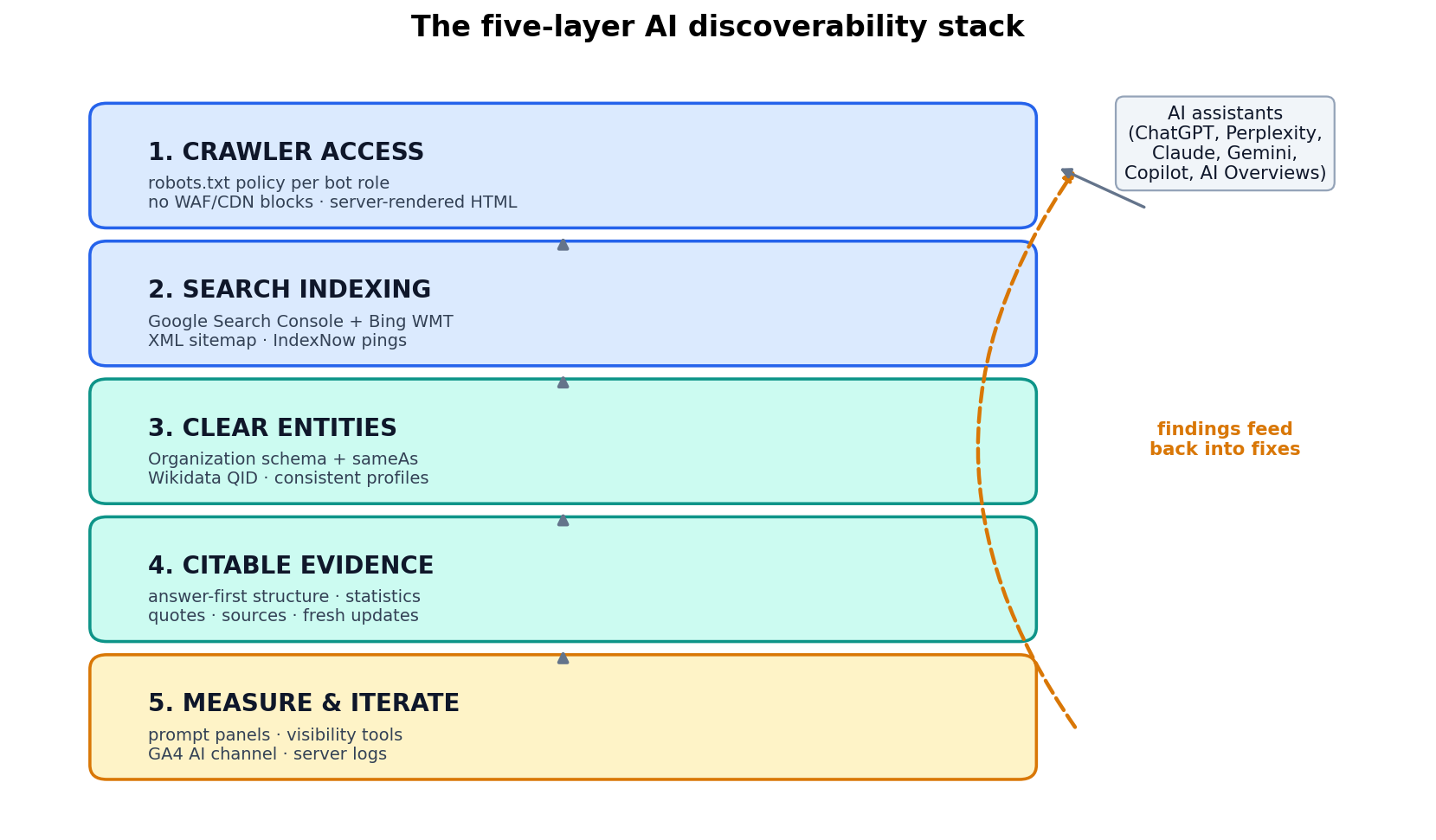
| Layer | Question to answer | Evidence that it works |
|---|---|---|
| 1. Access | Can the intended crawler or user-directed agent receive the public page? | Verified requests return useful 200 responses without a challenge |
| 2. Indexing | Can search and retrieval systems discover the canonical URL? | Representative pages are processed or indexed; sitemaps are accepted |
| 3. Entity clarity | Is it clear which organization, product, person, or website the page describes? | Visible facts, canonical identifiers, and maintained profiles agree |
| 4. Evidence | Does the page contain a specific claim an answer can support and attribute? | Citations use the intended page and describe its finding accurately |
| 5. Measurement | Does visibility lead to correct understanding and useful action? | Prompt results, referrals, and conversions improve without accuracy loss |
2. Define the outcome before changing the site
“Discoverable by AI” can describe at least four different outcomes. A crawler visit means a system requested the site. A brand mention means an answer names the website or company. A source citation means the interface exposes a supporting URL. A referral session means someone followed a link. These are related, but none proves the next.
| Outcome | What it proves | What it does not prove |
|---|---|---|
| Crawler request | An identified client attempted to fetch a URL | Indexing, use in an answer, or genuine identity unless verified |
| Brand mention | The generated answer contains the name | Correct facts, source attribution, or durable visibility |
| Visible citation | The answer exposes a page as support | That every claim came from that page or that the user clicked it |
| Referral visit | A measurable click arrived from an assistant | Total influence, because some interfaces suppress referral data |
| Qualified action | The visit produced a defined business outcome | Incrementality without a sound comparison or attribution method |
Choose a narrow benchmark that reflects the website’s job. A launch directory might track “where can I list a newly launched website?” and “find newly launched analytics websites.” A software product might track problem, use-case, comparison, and brand-fact questions. Include unbranded prompts so the benchmark measures discovery rather than recall of a name supplied in the question.
3. Choose crawler access by role, not by vendor name alone
Providers operate agents for different purposes, and the controls are independent. Review the official documentation before changing robots.txt because names, behavior, and published identity methods can change. As of this guide’s updated date, the principal roles are:
| Provider | Search or automatic discovery | User-requested retrieval | Model-development or data-use control |
|---|---|---|---|
| OpenAI | OAI-SearchBot surfaces websites in ChatGPT search | ChatGPT-User supports certain user actions; it is not the Search opt-out control and robots rules may not apply | GPTBot may collect content for training; it can be controlled separately |
| Anthropic | Claude-SearchBot supports search quality and indexing | Claude-User retrieves content at a user’s direction | ClaudeBot may collect content for future model training; Anthropic says its bots honor robots.txt |
| Perplexity | PerplexityBot surfaces and links websites in search results | Perplexity-User supports user actions and generally ignores robots.txt because the fetch is user-requested | Perplexity’s current crawler page does not list a foundation-model training crawler |
Googlebot affects Google Search, including its generative features | Agentic experiences use separate mechanisms as documented by Google | Google-Extended is a robots control token, not a separate crawler; it does not affect Google Search inclusion or ranking |
OpenAI’s crawler documentation explicitly says a publisher can allow OAI-SearchBot while disallowing GPTBot. Anthropic’s documentation describes the same separation across its three agents. Perplexity’s crawler documentation publishes both role definitions and IP endpoints. These are policy choices, not a requirement to allow every use.
Write explicit, maintainable rules
The following pattern allows the three documented automatic AI-search agents while repeating private-path exclusions for that group. It intentionally leaves model-training policy out of the example so the owner must decide it separately. Replace the sample paths with the site’s actual sensitive or wasteful areas.
User-agent: OAI-SearchBot
User-agent: Claude-SearchBot
User-agent: PerplexityBot
Allow: /
Disallow: /admin/
Disallow: /account/
Disallow: /api/

# Decide training policy separately after reviewing current docs:
# User-agent: GPTBot
# User-agent: ClaudeBot- Keep robots.txt at the production origin and return it without authentication, a challenge, or a redirect loop.
- Repeat any necessary private or faceted exclusions in a specific group; do not assume a wildcard group will be merged the way you intend.
- Use page-level
noindexonly where a crawler can fetch the directive. Blocking a URL in robots.txt can prevent the crawler from seeing the page-level instruction. - Do not place secrets behind robots.txt. It is a crawl preference file and publicly reveals the listed paths.
- Assign an owner and review the official bot pages quarterly or when a provider announces a change.
Verify identity at the firewall
A user-agent string is easy to spoof. Use the provider’s current published IP ranges, reverse-DNS method, cryptographic verification, or a CDN’s verified-bot classification. OpenAI and Perplexity publish role-specific IP files; Anthropic publishes an IP list; Google documents verification for its crawlers. Cloudflare’s verified-bot documentation describes verification using signed identity, published IP lists with stable user agents, or reverse DNS.
Do not create an unconditional WAF allow rule from the user-agent string alone. Combine identity with the intended role, route scope, rate policy, and logging. A forged “GPTBot” should not bypass controls for account, checkout, or administrative endpoints.
4. Verify what the crawler actually receives
A permissive robots file cannot override a CDN block, bot challenge, origin timeout, login wall, or empty client-rendered shell. Test the full path from the public edge. Request representative pages with each intended agent, then compare the status, canonical, robots directive, headings, main answer, links, and structured data with an ordinary browser response.
- 01
Start at the edge
Inspect CDN and WAF logs for the claimed request, verification result, action, response status, cache status, and origin status. Repeated 403, 429, 5xx, or challenge pages are access failures.
- 02
Inspect raw HTML
Use an HTTP client or View Source, not only the browser’s post-JavaScript DOM. The title, opening answer, important links, canonical, and index controls should be present in the initial response.
- 03
Check parity
Serve the same substantive public information to verified crawlers and people. Do not create crawler-only claims, invisible answer blocks, or structured data that visitors cannot verify.
- 04
Test failure paths
Check redirects, missing pages, rate limits, consent layers, geolocation, and image URLs. A crawler should receive honest status codes and should not be trapped in infinite URL combinations.
- 05
Monitor over time
Alert on repeated access failures by verified role. A successful one-off request does not prove that a later ruleset, managed challenge, or deployment still works.
5. Build the conventional search foundation
Search indexing remains part of AI discovery, but avoid undocumented dependency claims. Do not promise that a Bing ranking maps directly to a ChatGPT citation, or that an indexed page must appear in an assistant. The durable work is to make every canonical public page discoverable and eligible in the major search systems that expose webmaster controls.
- Verify the production site in Google Search Console and Bing Webmaster Tools.
- Submit an XML sitemap containing canonical, useful, indexable URLs and accurate modification dates.
- Link important pages through ordinary HTML navigation and contextual internal links.
- Inspect representative URLs for crawl, canonical, indexing, mobile, and structured-data problems.
- Use IndexNow to notify participating engines when canonical URLs are added, updated, or deleted; treat notification as a signal, not an indexing guarantee.
- Keep feeds, sitemaps, canonicals, redirects, and structured-data URLs on the same public origin.
- Remove stale placeholders, search-result permutations, private content, and unsafe or insufficient pages from public discovery surfaces.
Bing’s current webmaster guidance recommends combining complete sitemaps with real-time update methods such as IndexNow, while warning that no tool guarantees appearance in AI-generated results. Google says a page must be indexed and eligible for a snippet to appear in its generative Search features, but also states that crawling, indexing, and serving are not guaranteed.
6. Make the organization and website unambiguous
Create one stable entity home—usually the About page—that plainly states the organization’s name, canonical domain, product or service, audience, operating geography where relevant, contact route, ownership or publisher, and maintained official profiles. Keep those facts consistent on the homepage, guide bylines, legal pages, launch profiles, social accounts, and third-party listings.
Use structured data as a clarification layer
Use Organization and WebSite markup for visible, verified facts, with stable @id values that connect related nodes. Article or Report markup can identify a guide, research report, publisher, author, publication date, and revision date. sameAs should point only to official profiles the entity controls and maintains. Product, review, or local-business markup must meet the relevant eligibility rules.
Structured data does not create ownership, trust, or an AI citation. Google’s generative Search guidance says there is no special AI schema and structured data is not required for generative Search. Use it because consistent machine-readable facts reduce ambiguity and can support conventional search features.
Treat third-party knowledge bases carefully
Do not create a Wikidata item, Wikipedia article, Crunchbase profile, review-platform listing, or local-business profile merely to fill a supposed “entity stack.” Each service has its own inclusion, notability, conflict-of-interest, and accuracy rules. Use a profile only when the entity legitimately qualifies and someone can keep it correct. A fabricated or abandoned profile weakens the evidence rather than strengthening it.
One canonical name
Use the same public name and domain across the entity home, page metadata, schema, and maintained profiles.
One factual core
State what the website does, for whom, and within which limits before varying the copy for a channel.
Verifiable publisher
Show who publishes the site, how to contact them, and who is responsible for editorial or product claims.
Dated changes
Distinguish official launch dates from first-observed dates and keep material revisions visible.
Approved connections
Link only official profiles, verified people, products, and parent relationships; omit pending or inferred ownership.
Visible facts first
Every structured assertion should be available to a visitor in the page or an obvious supporting page.
7. Publish evidence an answer can safely use
Generic summaries give a retrieval system little reason to choose one source over another. Publish material that only the organization, its customers, or a properly documented research process could produce: first-hand implementation details, original aggregate data, reproducible tests, named definitions, current product facts, decision criteria, and honest limitations.
| Content pattern | Weak version | Citable version |
|---|---|---|
| Direct answer | “There are many things to consider.” | A concise recommendation with scope, conditions, and a link to the supporting detail |
| Statistic | An undated percentage copied from another summary | A dated number with period, sample, definition, method, and original source |
| Comparison | Promotional scores with no criteria | Named criteria, review date, evidence for each row, and limitations |
| Experience | Unverifiable claims of expertise | Specific inputs, steps, result, failure modes, and what may not generalize |
| Research | A chart without definitions or downloadable values | Methodology, reporting period, source cutoff, stable snapshot, correction notes, and aggregate data |
| Product fact | “Best-in-class AI platform” | Current capability, supported workflow, prerequisite, price basis, and documented boundary |
Write answer-first, then preserve the depth
Lead a page or section with the conclusion a reader came to find. Follow it with reasoning, steps, evidence, exceptions, and links to primary sources. Descriptive headings and compact tables make a long guide navigable, but Google explicitly says there is no required content “chunking” pattern or ideal page length for generative Search. The purpose of structure is to help people understand and verify the answer.
- Give every guide a specific primary question and answer it near the opening.
- Use a visible author or publisher, publication date, meaningful revision date, and correction route.
- Link technical and policy claims to current first-party documentation.
- Define the denominator, sample, geography, period, and source cutoff for quantitative claims.
- Place the source near the claim it supports and use descriptive anchor text.
- Show uncertainty, tradeoffs, exclusions, and cases where the recommendation does not apply.
- Retire a statistic or product comparison when its primary evidence can no longer be verified.
What the GEO study does—and does not—show
The 2024 GEO study by Aggarwal and colleagues evaluated 10,000 benchmark queries and reported that adding credible citations, relevant quotations, and statistics could improve its source-visibility measures, while keyword stuffing performed poorly. The work included a controlled generative-engine setup and a smaller Perplexity experiment.
That is useful evidence for accurate sourcing and specific facts, not proof of a universal 40% traffic lift or a direct ranking factor in today’s ChatGPT, Claude, Google, or Perplexity products. The authors note domain differences, black-box systems, and the need for methods to adapt. Use the study as a reason to improve evidence quality, not as a promise in a sales deck.
8. Earn independent corroboration without manufacturing mentions
An organization can define itself, but independent sources help a reader or retrieval system evaluate whether other people have observed the same thing. Seek references where the audience already learns: relevant publications, expert newsletters, standards communities, customer case studies, launch directories, review platforms, professional associations, podcasts, and substantive forum discussions.
- 01
Create a citation hook
Publish a useful dataset, methodology, benchmark, teardown, implementation lesson, or public tool that another source can discuss on its own merits.
- 02
Match the source to the audience
Pitch a finding to a journalist or newsletter that covers the topic; submit the product to a directory whose visitors actually evaluate this category.
- 03
Make verification easy
Provide the canonical URL, short factual description, methodology, current media assets, contact, and any limitations or conflicts.
- 04
Disclose the relationship
Identify founder, employee, customer, sponsor, affiliate, or paid-placement relationships. Never condition an incentive on positive sentiment.
- 05
Maintain the footprint
Correct material errors, keep official profiles current, and record which independent pages accurately support which public facts.
Do not buy bulk mentions, create fake reviews, seed undisclosed endorsements, or open accounts only to repeat the same claim. Google explicitly warns that inauthentic mentions are not a shortcut for its generative Search features. The dedicated launch directories guide provides a quality and audience-fit scorecard for submissions.
9. Treat llms.txt, schema, and “AI writing” claims proportionately
| Tactic | Reasonable use | Do not claim |
|---|---|---|
llms.txt | A concise optional manifest linking to canonical guides, research, methodology, feeds, and sitemaps | That it is a ranking factor or guarantees ingestion; Google says Search ignores it |
| Structured data | Clarify visible entities, page types, authorship, dates, and relationships | That special “AI schema” is required or creates an assistant citation |
| Short answer blocks | Help readers reach the conclusion quickly before the supporting depth | That every answer must have a fixed word count or artificial chunk size |
| Frequent updates | Correct changed facts and add genuinely new evidence | That changing a date alone creates freshness or visibility |
| AI-generated drafts | Support research organization, outlining, or editing with human verification | That scaled generic pages become valuable because they are fluent |
| Prompt tracking tools | Automate repeated observations across selected assistants | That a vendor can expose an assistant’s private ranking system or guarantee placement |
An llms.txt file is low-cost when the site can keep it accurate, but the canonical HTML, sitemap, feed, metadata, and internal navigation still carry the real discovery work. If the manifest drifts from the public site, delete or repair it. Do not create Markdown duplicates of every page merely to satisfy an unproven convention.
10. Measure mentions, citations, accuracy, and value separately
Build a stable benchmark before making changes. For a small founder-focused site, 20 well-chosen prompts across five intent groups is often more useful than hundreds of vague variations. Run the exact wording in a fixed locale and account state across the assistants that matter to the audience. Record the model or product surface when it is visible.
| Field | What to record | Why it matters |
|---|---|---|
| Test context | Date, platform, surface, locale, account state, exact prompt | Makes later runs comparable and exposes context changes |
| Visibility | Brand mention, position or prominence, recommendation context | Separates presence from favorable or relevant presence |
| Citation | Visible link, cited URL, nearby claim, competing sources | Shows which page and evidence the interface selected |
| Accuracy | Correct, incomplete, stale, ambiguous, or false facts | Prevents a prominent but harmful answer from counting as success |
| Traffic | Referral source, landing page, engaged visit, campaign where available | Measures observable click-through while acknowledging undercounting |
| Outcome | Free check, signup, submission, profile claim, sale, or another defined conversion | Connects visibility to the website’s actual job |
A practical operating cadence
- Weekly
Watch access and referrals
Review verified crawler response codes, unusual crawl loops, assistant referral landing pages, and conversions. Investigate repeated 403, 429, or 5xx responses.
- Monthly
Repeat the prompt benchmark
Run the fixed panel, preserve the answer evidence, compare mentions and citations, audit accuracy, and identify which competing sources now support the answer.
- Quarterly
Review policy and content
Check official crawler documentation, robots and WAF rules, public entity facts, material source changes, stale comparisons, and prompt relevance.
Google now documents a Generative AI performance report in Search Console for its generative Search and Discover features. Use it when available to the verified property, and keep conventional search, assistant prompt observations, analytics referrals, and server logs as separate datasets. No third-party visibility tool has access to a provider’s private ranking systems.
11. Follow a dependency-aware 90-day plan
Days 1–14
Establish access
- Define the search, user-fetch, and training policy.
- Audit robots.txt by role.
- Verify official identities at the CDN/WAF.
- Test raw HTML and representative response codes.
- Record the initial 20-prompt benchmark.
Days 15–30
Strengthen indexing and identity
- Verify Google and Bing properties.
- Submit the sitemap and configure IndexNow.
- Repair canonical and internal-link gaps.
- Publish or improve the entity home.
- Validate visible-data parity in structured data.
Days 31–60
Publish evidence
- Improve high-intent pages answer-first.
- Add primary sources, dates, and limitations.
- Publish one original aggregate finding or first-hand resource.
- Expose a stable methodology and correction route.
- Pitch the evidence to a few relevant third parties.
Days 61–90
Close the loop
- Repeat the benchmark in the same context.
- Compare cited URLs and competing sources.
- Correct inaccurate entity facts.
- Fix crawler failures and weak landing pages.
- Keep only tactics that improve accurate visibility or qualified outcomes.
Day-90 review questions
- Do all priority public pages return useful initial HTML and honest status codes?
- Can verified search and user-directed agents reach the routes the policy intends to expose?
- Are the canonical website, publisher, product, and official-profile facts consistent?
- Does every important claim have current evidence, a definition, and an accountable source?
- Has the unbranded prompt citation rate improved without a decline in factual accuracy?
- Which pages are cited, which outside sources corroborate them, and what gaps remain?
- Is there a measurable assistant-referral and conversion baseline, even if the volume is small?
12. Keep the evidence hierarchy visible
Documented prerequisites: provider-specific crawler controls, useful public access, search eligibility where a product relies on a search index, and accurate visible content. Supported but conditional practices: original evidence, clear sourcing, structured entities, and independent corroboration. Observational signals: correlations between mentions, rankings, links, or platform visibility; these can guide an investigation but do not establish a cause. Unproven shortcuts: guaranteed citation percentages, magic word counts, universal prompt formulas, AI-only schema, and ranking promises tied to llms.txt.
Platform behavior changes, assistant outputs are probabilistic, and a provider can choose not to crawl, index, retrieve, cite, or link a page that meets every published guideline. The durable strategy is to be accessible by deliberate policy, easy to identify, useful to people, specific enough to verify, corroborated where appropriate, and measured with honest baselines.
Continue with the website discovery guide for the wider search, directory, community, and customer system; use the website launch checklist to verify the live page before promotion.
Frequently asked questions
Does llms.txt make a website rank in AI answers?
- There is no general ranking guarantee. Google states that it does not use llms.txt for Search. Treat it as an optional navigation aid for systems that choose to read it, not as a substitute for crawlable HTML and search indexing.
Which OpenAI crawler affects ChatGPT search?
- OAI-SearchBot is used to surface sites in ChatGPT search. GPTBot is associated with potential model training, while ChatGPT-User supports some user-initiated requests.
Is structured data required for AI citations?
- No. Accurate structured data can clarify entities and page types, but assistants still need useful, accessible, trustworthy content and retrieval access.
Sources and methodology
LaunchIndex Research reviews this guide against primary documentation and the public LaunchIndex methodology. Platform behavior can change, so the updated date is part of the record.
- OpenAI crawler documentation
- Anthropic crawler documentation
- Perplexity crawler documentation
- Google generative AI search guidance
- Google crawler and Google-Extended documentation
- Cloudflare verified bot documentation
- Bing guidance on sitemaps in AI-powered search
- IndexNow protocol documentation
- GEO: Generative Engine Optimization (KDD 2024)
Explore LaunchIndex data
Browse the new website directory or review published aggregate research. Launch profiles record when LaunchIndex first observed a public website live; they are not claims about an official launch date.